How to Play Games With Your Friends When You’re an Adult With No Free Time
Gaming with my friends is pretty much the reason I do any of this other stuff.
But, like many people, as I’ve been getting older my life has been filling up and I’ve found it more and more difficult to set aside 3+ hour blocks to luxuriate in an extended gaming session like I used to. And so to get around this, I’ve been experimenting with asynchronous, online games with my friends. The idea being that instead of having a sustained large gaming session with friends I can check in with a game during lunch time, or when I have 30 minutes before bed and give it a bit of a poke at my schedule.
Here's some of the different games I've tried - what worked, and what didn’t. This is a continuing project of mine and so I’d love to hear about what other people do in this space - comments below.
Table of Contents
- Slow Games
- Through The Ages
- Play By Post RPG
- Chess
Slow Games
This was the first type of game that we tried. A type of game played out on discord where you’d make one move a week.
The Failure: Diplomacy
Maybe you’ve heard of the board game Diplomacy - this where a group of players take control of various European powers during WW1 and commit war upon each other? During covid lockdowns my friends and I decided to play a game of this together for the following reasons:
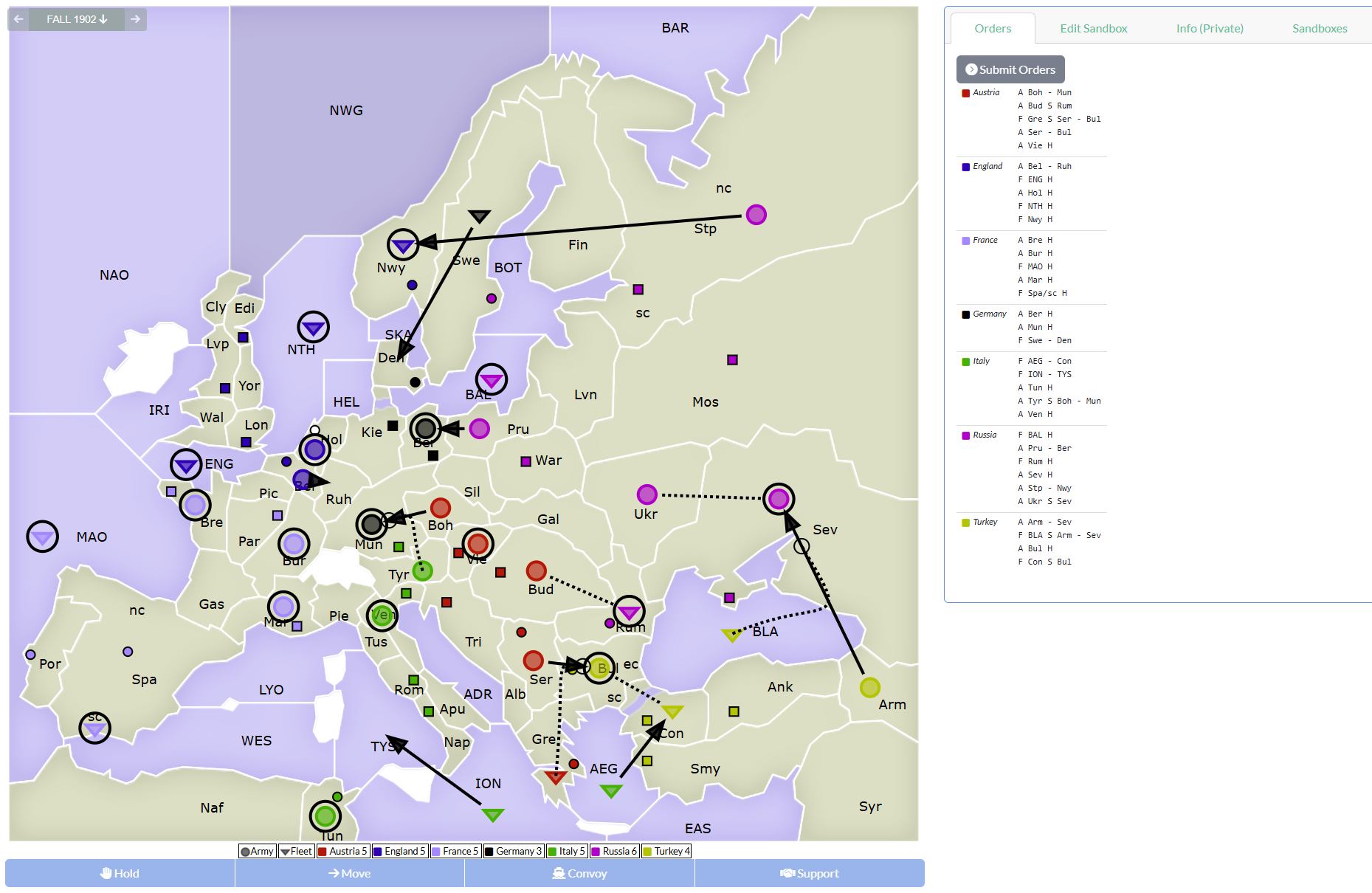
- It has a free online implementation called backstabbr
- The game includes no element of chance, your performance in the game is purely down to strategy and your ability to negotiate with your friends.
- We get to make a single move once every few days, meaning that we can play whenever we want around our schedules.
Unfortunately, like every online game of Diplomacy I’ve played, this completely fell apart after a few weeks for one simple reason: It feels horrible to be lied to.
When the entire game is based around scheming with and against your friends, it can be easy for the emotions of the game to bleed through and become the emotions you feel about your actual friends. “I can’t believe that Jon would lie to me like that”. It's also just a very intense experience! It's the ultimate zero sum game.
Pros
- The backstabbr will run the game for you
- Only requires a single move a week
- Deep strategic and diplomatic gameplay
Cons
- Requires the players to understand all the rather complicated rules, inputting an invalid move is a pretty sad outcome
- The super tight gameplay and encouragement of backstabbing each other leads to a very tense game and some significant feel bad outcomes
The Success: Matrix Games
These are somewhere between an RPG and a boardgame and inspired by military wargaming. Based on a blog post by Chis McDowall talking about his own experience running these - one of my friends made a scenario and ran us through it.
Overview
- We were given a shared started setting description including a rough map
- Each player was given a unique factions with some amount of secret information and goals
- Each week we would each send one single action in secret to the person running the game, adding in reasons why we thought that action would succeed.
- Each Sunday the person running the game will roll to see which actions are successful, providing bonuses to actions with a strong narrative justification.
- After determining which actions were successful the person running the game would create an in-game news report, detailing what happened over the past time period.
- After seven weeks of gameplay we finished up and had a call where we talked about everything that happened and assess if we met the goals for our factions.
This was a massive success. The scenario my friend ran was based around a papal succession crisis in a fictional early industrial city. Some of the factions were noble houses trying to position themselves as having a member become the new pope. My faction were industrialists who were trying to leverage the political instability to gain a charter to create a new railway, another faction were trying to create a proletariat uprising in the farmland outside the city.
The game immediately went off the rails in the best way when for reasons I’m still not sure on where there was a large visit to my industrial town, very quickly changing the focus of the game in a way none of us expected. The game culminated in a multi-way sequence of attempted assassinations and counter assassinations as the newly elected pope attempted to reach the safety of their papal seat.
Unlike Diplomacy there was this really delightful ambiguity that we were able to play with. During the week around making our moves we would create little bits of roleplaying and propaganda that we would send to each other. You were able to hatch up schemes and make up stories about the people in your faction.
Below is an in-universe newspaper I created one turn for a different game that I was running. Creating little artifacts like this is one of the big joys of the game.

Pros
- You can make your once a week in your own time
- However, the roleplay allows you to engage with the game as much as you’d like
- Doesn’t require any real rules to understand from the players as you can just say what you’d like to do.
- Resistant to having players drop out
- Opportunities for really expressive gameplay
Cons
- Requires someone to create and manage the experience.
- Setting up the communication infrastructure to manage the game can take some work (we used discord).
- Required the players to buy into the scenario
Through the Ages
Boardgames! They’re cool, right? You go over to your mate’s place, they pull out a huge box, spend 15 to 40 minutes explaining rules to you and then you spend 2 to 6 hours playing some complicated game with a thousand components. Requires lots of space, lots of time and a miracle of scheduling to pull off.
Through the Ages is a really fantastic board game that comes closest to capturing the experience of playing Sid Meier's Civilization. Up to four people play a civilization starting in prehistory, research upgrades, build buildings and go to war on each other. It’s really quite a special game but it has a lot of busy work with moving tokens and cards around, counting how many of each resource you’re meant to have and a lot of waiting around while your friends make their turns.
Luckily it has a fantastic videogame implementation on phone and PC that goes rid of all the busy work! It has a great tutorial to teach you the rules, the game then supports you while you’re playing to remind you how to play - and the best part is that you can play asynchronously, so you don’t need to wait for your friends to make their moves. You can just go about your day and your friends will make their moves as they’re ready.
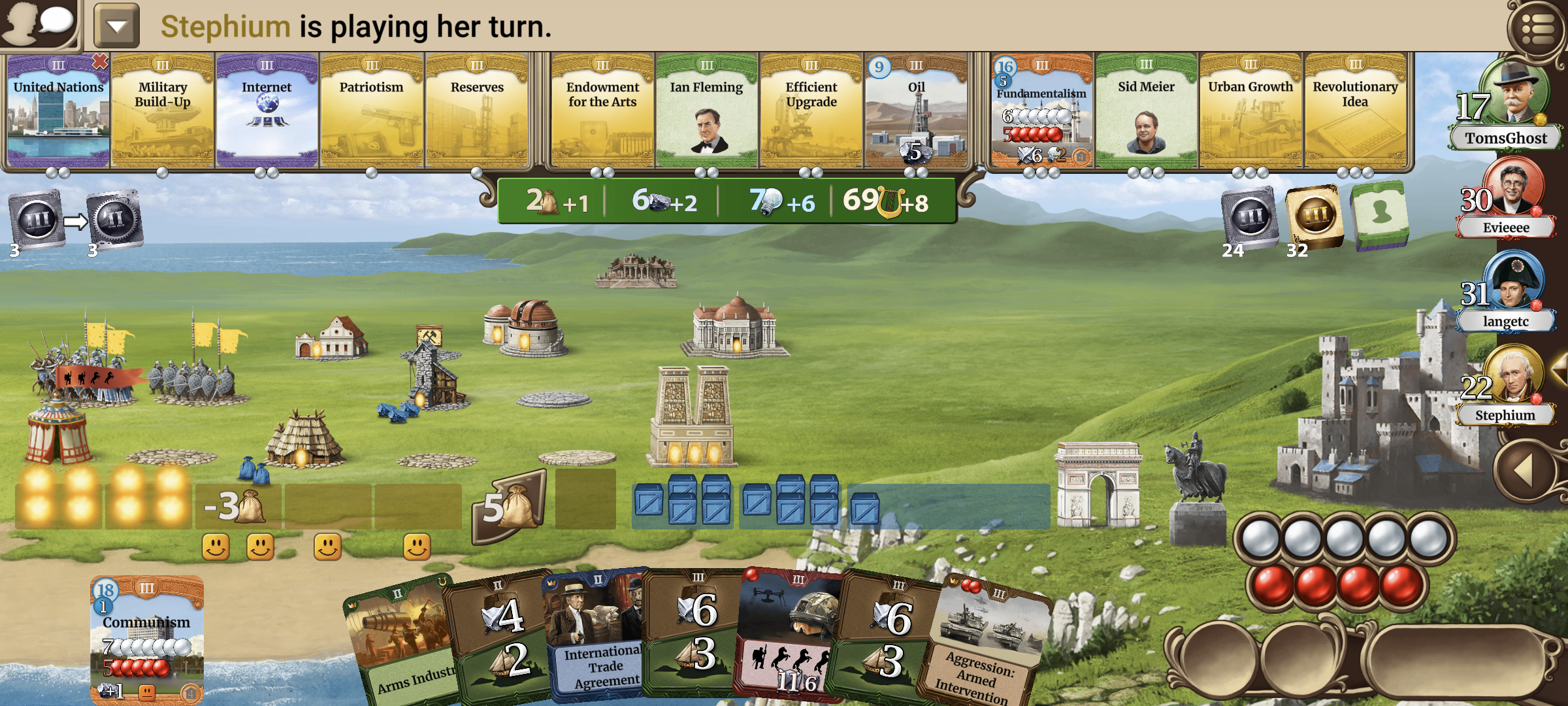
But the game still has plenty of bite. Through the Ages is an engine building game, where you try to set yourself up to have bigger and bigger turns until you create the biggest, most amazing civilization. However, I often find that my engine is misfiring, locking up and coming to a stand-still as each turn feels more and more like I’m doing my taxes and not liking the result.
Which, to be clear, rules.
If you’re an intense, engine building sicko this is the perfect game for you.
Pros
- Play it at your own place
- Each to pick up
- Really fun and cool
Con
- Can be stressful when your engine doesn’t work out
- Maximum four player count
- The game wasn’t designed to be played via phones and some rules were tweaked to make the game flow better but certain events (like bidding for colonies and proposing pacts) still slow the game down as you need to waiting for other player input before continuing the game
Play By Post RPGs
If it’s not clear, role playing games are kind of my main deal. Whenever I don’t have a game going I’m thinking about all the things I want to do in my next game - when I do have a game on it’s the highlight of my week.
Unfortunately for reasons outside of my control doing a fortnightly RPG isn’t something that I can do right now BUT listening to the excellent podcast Between Two Cairns one of the hosts talks about how much success he’s had doing running his game play by post - which is to say that instead of doing your game of Dungeons and Dragons (Blades in the Dark, or Thirsty Sword Lesbians, or Good Society) in person you do it on discord via text. He goes into his system of how he did it here: https://newschoolrevolution.com/how-i-do-play-by-post/
And
Unfortunately
This didn’t work for me at all.
I grabbed three people I was really excited to play a game with, picked a game we all seemed excited about (Iron Valley if you’re curious, a co-operative game based on Stardew Valley) made some characters, got the game running and then... It just didn’t work. Actually playing the game took a load of effort and we all found ourselves procrastinating out moves until it just... petered out.
Perhaps if we had chosen something a bit less high concept and more traditional (a single GM leading a party through a dungeon instead of an open ended GMless experience) it would have been easier but oh well, it’s a learning experience. I haven’t given up on the Play By Post Lifestyle so watch this space.
I’d really love to hear from people who’ve had a positive experience with play by post as I think it’s a really fascinating format of play and one what I want to revist
Chess
Have you all heard of this?? Chess? Kings, pawns and all that jazz?
One day out of the blue one of my friends challenged me to a game of chess, and having never played it seriously I was shocked to discover that it was really fun. We played a few more times over the next few weeks but that wasn’t enough for me so I opened an account on chess.com and started challenging my other friends to games.
This triggered an epidemic of chess playing as we all started playing chess against each other all the time on our phones just as we went about our days.
Generally we would play with a 3 day time limit on any given move - so when you’d be at the cafe waiting for your order you could just pull out your phone and start working your way through your queue of moves (because I’d have a game going with each of my friends generally there would be a little backlog of moves to do).
This had some immediate effects
- We all quickly became a lot better at chess.
- I started using social media on my phone less.
- I thought about chess a lot.
The story that I’d heard about chess is that it's kind of pointless to learn to play because it’s all about memorization of openings and only the best chess players get to make up moves on the fly.
This hasn’t really been my experience. I spent a bit of time learning about some possible openings but really most of my learning has been organic discoveries about the game.
Early queens is a good example of this - when I started playing I thought that you’d want to get your queen out as early as possible because well, it can go anywhere. When your opponent has a queen out they have a lot of options so there’s a lot for you to keep track of. But then as I played more I slowly discovered that leaving pieces unprotected (that is, leaving a piece in a situation where if an opponent takes it, I can’t immediately take their piece back) is generally a bad idea and suddenly early queens aren’t scary at all. What’s it even going to do - take my piece? I’ll just take it back. It might be that as I play longer I’ll develop my opinions about chess more and early queens are actually good if you’re playing at a higher level than me.
The point of all this is - if you’re thinking that you can’t play chess without spending dozens of hours learning opening moves, that’s simply not true.
Pros
- Free
- Play at our own pace on the mobile app
- Lots of people know how to play it
- Get to have the experience of looking up a particular play and learning it was invented 500 years ago
Con
- You have to be okay with losing if your friends are much better than you (handicap mode is a thing however, where one side starts with fewer pieces)
- If you’re like me you can be stuck ruminating on possible moves for a very long time