I Ran Eat the Reich 5 Times at a Convention and this is what I Learnt
Over the weekend I took part in Conquest, Melbourne's largest tabletop convention. There I got to run Eat The Reich five times over two days. I wanted to record my experiences so I could provide some advice for anyone else who wants to play the game. This isn't a review or even a guide on how to run the game - just my opinion on what makes the game run smoothly.
So What Even Is Eat The Reich?
So in case you don't know anything about this game, Eat the Reich is an over the top hyperviolent RPG where you play as bloodthirsty vampires cutting a bloody path through Nazi occupied Paris with the goal of killing Adolf Hitler and drinking all his blood.
The rules set comes with the single scenario (though you can pretty easily expand it out to do other things). It's just about the right length for a one-shot and to me - that makes it perfect for running at a convention.
Print off the Character Sheet Spreads in Colour
One of the immediately obvious thing about Eat the Reich is how good the art is and frankly, I think it would be a shame if only the GM gets to look at it. I printed off the character sheets as big as I could, as well as any art of the enemies and locations that I could use as props. All my players really liked it and it was a great way to get them excited about the start of the game.
How I Start a Session
One of the hardest part of an RPG is transitioning from being a bunch of people sitting around a table talking to playing a game. This is even worse when you're running a one shot where you:
- Don't know anyone
- You have to teach them the system too
So after a few systems I developed a script I'd use to teach the game and get them playing.
- I'd read the briefing from the rules book. This introduced them to the concept of the game and helps situate themselves in the fiction.
- I hand out character sheets, and read out the description from the book describing who each character is best for.
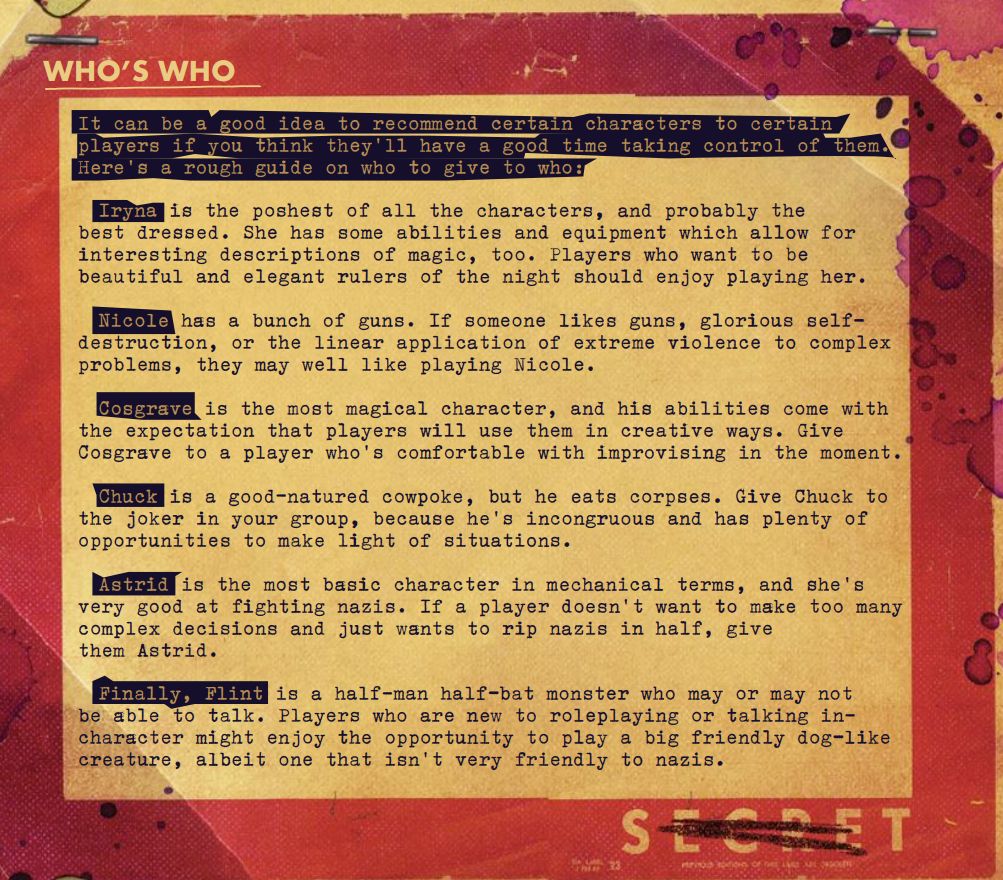
- I run the players through their character sheets while making an example move. I explain what their stats mean, how they use their stats to build a dice pool, how equipment works etc. I don't yet explain how allocating dice works though.
- I start the game by landing the players in the Place De Le Sirene - mostly because I really like the contrast between how beautiful the location is and then how chaotic it becomes when the vampires arrive.
- I have one of the players describe their dramatic entrance and have them build their pool of dice and roll - this is the point where I roll against them and show them how allocating dice works.
- After the first round is complete I run them through the reinforcement rules and describe how there are too many Nazi's in Paris to fight them all.
- And that's basically it! After that the game runs itself more or less.
New Rule: Add Allocating Successes to Pick Up a New Equipment
I added this rule in my final game of the convention. One of the options that is a bit harder for players to remember is that once per objective you can conjure a piece of equipment out of nowhere, assign it to your character and the GM will create stats for it. The players I had, especially in the context of a one shot, never really felt comfortable doing this.
To help alleviate this I added "pick up a piece of equipment or create one" as a sixth thing you can allocate successful dice to. This achieves two things:
- It helps make players feel more comfortable creating new equipment and it reminds them that they can.
- It adds a bit of structure to the scenarios that begin with a bunch of loot on the ground. Allocating a success to pick the loot up means that the players can't just grab the loot (that isn't already behind a sub-objective).
Don't Let The Players Go Anywhere
Eat The Reich provides a very cool map of Nazi occupied Paris that I'd intended on printing and placing on the table, I'm really glad I didn't get around to doing that now because it would have been a disaster.
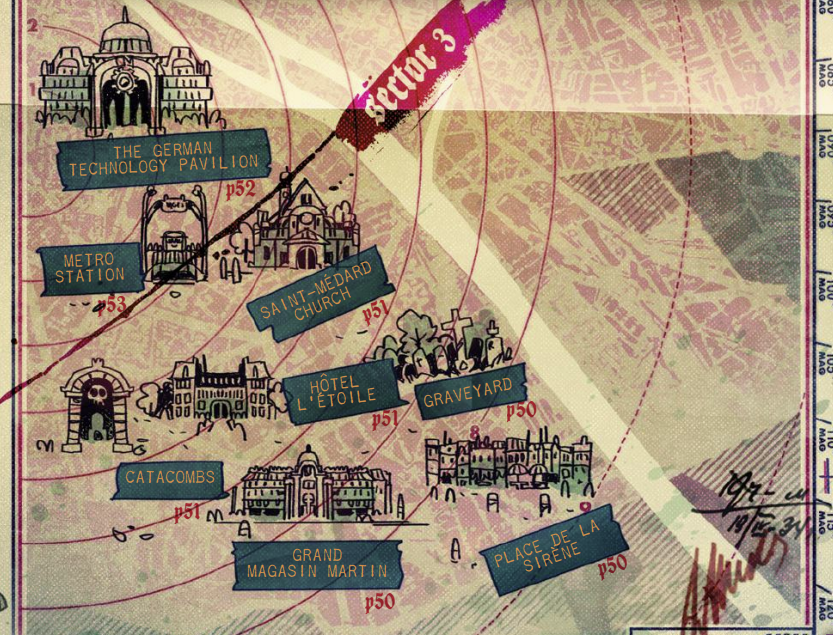
Instead of letting players pick any location on that map for the sector they're in I'd provide some kind of choice in the narrative like "you need transport if you want to get further into the city - do you want to go into the underground metro, or raid the expensive looking garage" or "you need to arm yourselves before you go further in, do you want to go to the German Technology Pavilion or the Museum of European Warfare". I think this made the choices feel more digestible for the players, instead of going "here's a map of Paris, where are you heading",
By the end of the game I'd started to form my own opinions on which scenarios are really and started herding or just directing players to the locations I thought were more interesting. Which btw, as GM you're totally allowed to do! Especially in the context of running a game five times in a row, it's got to stay fresh for you too! My personal favourite are the metro (which usually ends in train to train combat) and the German Technology Pavilion (because of all the cool stuff the players get to steal).
I'm Bad at Assigning Threats
There's some content in the book that talks about how threats only roll against players that they're engaged with. When I ran the game all of the threats were kind of engaged to all of the players all the time unless there was really extenuating circumstances.
This might have been a flow on affect of me being very permissive in what I allowed players to allocate their dice to. Generally if players had a spare success on their dice I was more than happy to allow them to allocate it to advancing the objective - if players are allowed to not be engaged with threats than they can really quickly knock out the objectives.
I don't know what I'd change about this one but it's an issue I noticed between the intent of the game and how I played it. I'd love to hear the thoughts of other people who've run the game and how they handled that.
Closing Thoughts
So - that's what I learnt after running this game for 15 hours. I'd love to hear what thoughts other people have had or let me know if this helps you out. One day I might look at writing my own scenarios for this game, the back of the book has a few historical suggestions but I feel like moving to a modern setting could be really fun.